
In 2023, the “Overall Layout Plan for the Construction of Digital China” issued by the Central Committee of the Communist Party of China and the State Council proposed to promote the deep integration of digital technology and the real economy, and accelerate digital technology innovation in key areas such as agriculture, industry, finance, education, medical transportation, and energy. application.
The introduction of relevant policies and plans points out the direction for building digital intelligence capabilities and drives industry renewal. On December 28, the 2024 ICT Industry Trends Annual Conference, organized by Communications World All Media, with the theme of “Digital Technology Accelerates the Formation of New Productivity”, was held in Beijing. At the meeting, Zhang Jin, General Manager of Tencent Cloud Operator Industry, delivered a keynote speech titled “Advancing Digital Intelligence and Renewing the Industry.”
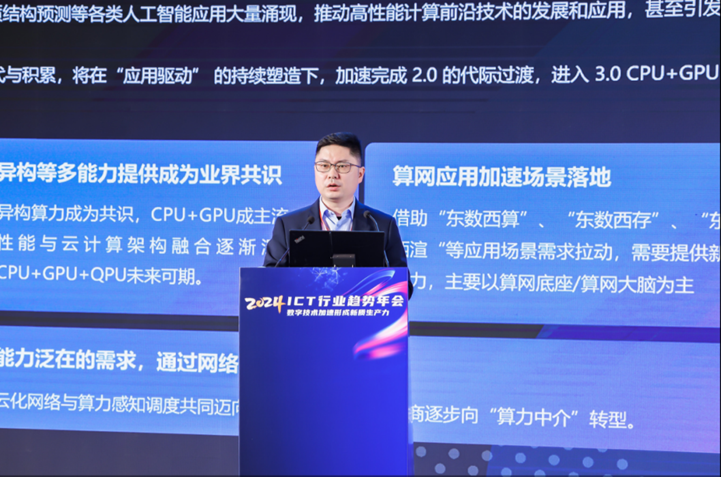
Zhang Jin said that the development of the ICT industry can present at least six major trends, which can also be summarized as “six new”: new capabilities, new applications, new connections, new experiences, new collaborations, and new paradigms.
1. New capabilities: with “connection + perception + computing” as the core
The industry accelerates towards the era of intelligent computing
Currently, computing power is the core productivity of the digital economy and a new capability supply, which is driving the digital economy to become a new growth pole. In Zhang Jin’s view, the whole society has put forward higher requirements for the supply of computing power: ubiquitous access, full-process perception, and trusted computing, making computing power a free-flowing “water.”
In recent years, various artificial intelligence applications such as large models, AIGC, autonomous driving, and protein structure prediction have emerged in large numbers, promoting the development and application of cutting-edge high-performance computing technologies, and even triggering epoch-making leaps, which deserve continued attention from the industry and society.
“Heterogeneous computing power has become the consensus, and CPU+GPU has become the mainstream.” Zhang Jin said that the iteration and accumulation of high-performance computing in terms of architecture, hardware and software will accelerate the completion of 2.0 under the continuous shaping of “application-driven” Generational transition, entering the new era of 3.0CPU+GPU+QPU.
At the same time, computing network applications are accelerating the implementation of scenarios. Driven by the demand of application scenarios such as “Eastern Digital and Western Computing”, “Eastern Digital and Western Storage” and “Eastern Digital and Western Rendering”, new capabilities need to be provided, mainly computing network base/computing network brain; the demand for ubiquitous capabilities also It needs to be gradually implemented and iterated through the network, and the cloud network and computing power-aware scheduling will jointly move towards “computing and network integration”.
2. New applications: implementation of industry applications for subdivided fields
Become the value tipping point for large models in the industry
AIGC is a key technology that breeds new formats of the digital economy and injects new momentum into the development of the digital economy. “The main battlefield of general large models is the To C field, and for large models to generate commercial value, they need to be positioned in the ToB field, that is, proprietary large models.” Zhang Jin believes that large models expand the possible boundaries of AI applications, compared with the past Scenario-based AI applications, combined with improvements in computing power and adaptability at the hardware level, significantly enhance the performance of large models, enabling the implementation of a diverse range of executable tasks.
For communication operators, industry large models drive the “emergence of wisdom”, including operators’ intelligent customer service, content production, network optimization, security risk control, smart marketing and many other business scenarios. Segmented scenarios have become their best “training ground” “.
Zhang Jin said that the entry path for large-scale model ToB should be expanded from high-value pilot areas to the MaaS ecosystem; while ToC has reached a critical point of availability, focusing more on efficiency and experience value.
In addition, with future organizational changes, individual and small team models may become important, causing the business boundaries between ToB and ToC to further blur, making B-side super APP products with C-side experience possible.
3. New experience: “Instant holographic communication” comes into reality
Promote efficient interaction and experience improvement of intelligent agents
With the gradual maturity and widespread application of mainstream technologies such as audio and video, digital twins, remote interaction, extended reality, artificial intelligence, blockchain, and cloud computing, the connection between the digital world and the real world has become closer, and people and The interactive experience between all things is more real, and the exchange of information between various fields is more unhindered.
The era of Quanzhen Internet is accelerating. This is not only the inevitable direction driven by technology, but also the inherent demand of social and industrial upgrading.
“Quanzhen Internet has two types of core technologies, one is twins, and the other is remote interaction.” Zhang Jin said that digital twins create 1:1 restored digital twins for people, objects, and environments, allowing the digital and real worlds to connect with each other. Mapping and fusion, real-time synchronization and two-way feedback are the manifestations of true interconnection, digital and real integration; remote interaction promotes the comprehensive integration of the digital economy and the real industry, breaks physical limitations, and establishes remote interaction capabilities, which is the interconnection of everything between digital and real things. Interoperable information channels promote human-machine collaboration.
4. New collaboration: digital office moves from “online” to “on-site”
and start knowledge co-creation
Digital office collaboration is becoming popular around the world. According to estimates by remote office space provider IWG, 70% of employees around the world work remotely at least once a week. In addition, IDC data shows that by 2023, 70% of the world’s 2,000 companies or organizations will use remote or A hybrid office-first working model.
Communication “presence”, collaboration “borderless”, and knowledge “co-creation” are the three major trends in digital office. Communication “presence” means face-to-face communication with distant partners without being restricted by time, location, equipment, or network. Tencent Cloud Real-time audio and video technology enhances auditory immersion and realizes “sound” immersion; collaboration “unbounded” means that digital collaboration technology will three-dimensionally improve digital office productivity in the four dimensions of “people-content-function-AI”; knowledge “shared” “Creation” refers to the paradigm innovation in which digital productivity spills out of the office and graph-based collaboration triggers knowledge co-creation.
Zhang Jin believes that through the widespread application of digital collaboration tools and knowledge digitization, the development of digital office collaboration will be further promoted, making future digital offices increasingly “multi-modal” and “grand collaboration”, and triggering paradigm innovations in knowledge co-creation.
5. New connections: 5G applications enter the fast lane, and 6G layout speeds up
The process of industrialization and scale is accelerating
As of March 2023, 5G networks have covered 30.2% of the world’s population, and 252 network operators in 92 countries/regions around the world have announced that they have begun to provide 5G services. All parties in the industry chain are highly concerned about how to build a sustainable business model to more effectively release the commercial value of 5G technology.
“5G converged applications have entered a critical period, currently mainly involving the three major areas of information consumption, real economy and people’s livelihood services.” Zhang Jin said that the emergence of digital content businesses is accelerating. As high-definition videos, cloud games, and AR/VR applications gradually mature, 5G/6G digital content services have given birth to new industries, new formats, and new models.
In terms of 6G technology evolution, 6G has extended the capabilities and functions of the original 5G technology, making outstanding breakthroughs in many aspects such as mobility, link range, and intelligence. Typical scenarios are It has a disruptive effect on the existing urban appearance: including urban digital layering, awareness recognition assistance, etc.
The value of industry private networks is also being fully unleashed. Zhang Jin said that 5G/6G private networks are deeply integrated with edge computing, and cloud network capabilities are accelerated to extend to upper-level applications, promoting the scale and value of industry solutions.
With the adaptation and support of AI and audio and video technologies, 5G/6G networks will quickly gain application-level connectivity and sharing in ubiquitous scenarios. In Zhang Jin’s view, technological innovations such as 5G/6G, IoT, and MEC will jointly promote the future network of “instant holographic communication” into reality.
6. New Paradigm: Promoting Industrial Upgrading through the Integration of Data and Reality
Leading a new cycle of value with the new digital paradigm
Digital-real integration and industrial symbiosis will usher in the next decade of digital innovation. How does the integration of data and reality help form new productive forces? How to drive a new value cycle?
Zhang Jin said that during the critical period of transformation of old and new driving forces, building an innovation paradigm for industrial digitalization will most likely lead to evolution in three aspects, including connection evolution, model evolution, and value evolution. The construction and upgrading of my country’s digital economic infrastructure is imperative. Operators play an important role in this and will lead technical support for industrial digitalization in many fields, providing computing power services and cloud network integration applications for government cloud, central state-owned enterprise industry cloud, etc.
At the same time, digital technology is the key driving force of the digital economy. It is necessary to continue to increase the research and development of emerging technologies such as AI, blockchain, and digital twins, strengthen the independent construction of core capabilities, create scenario applications of new technologies, and release new momentum for the digital economy.
“Tencent’s core concept of participating in the industrial Internet is C to B. This C is connection. Our ultimate goal is symbiosis and win-win.” Zhang Jin finally emphasized that for thousands of industries, Tencent Cloud hopes to create new businesses with partners scenarios, develop new cooperation models, iterate new business forms, and create a new paradigm of industrial digitalization with ubiquitous connections and smart computing power.